
Crimped fasteners are engineered fastening components that utilise a controlled mechanical deformation method to secure a permanent connection. Rather than being held in place by a combination of friction and thread tension, a crimped fastener is physically deformed onto a mating part when installed, creating a permanent mechanical lock to resist loosening under vibration and load.
Because of this mechanism, crimped fasteners are a preferred choice in industries where the integrity of connections is critically important, such as cement and steel plants, power generation, marine and offshore equipment, heavy industrial machinery, and construction. This article discusses how they work, the main types manufactured for industrial use, benefits and applications.
What are crimped fasteners?
Crimped fasteners are fastening components that are secured by deforming a defined section of the fastener when installed. The deformed section ensures a mechanical lock that prevents the fastener from loosening beyond what thread engagement alone can provide.
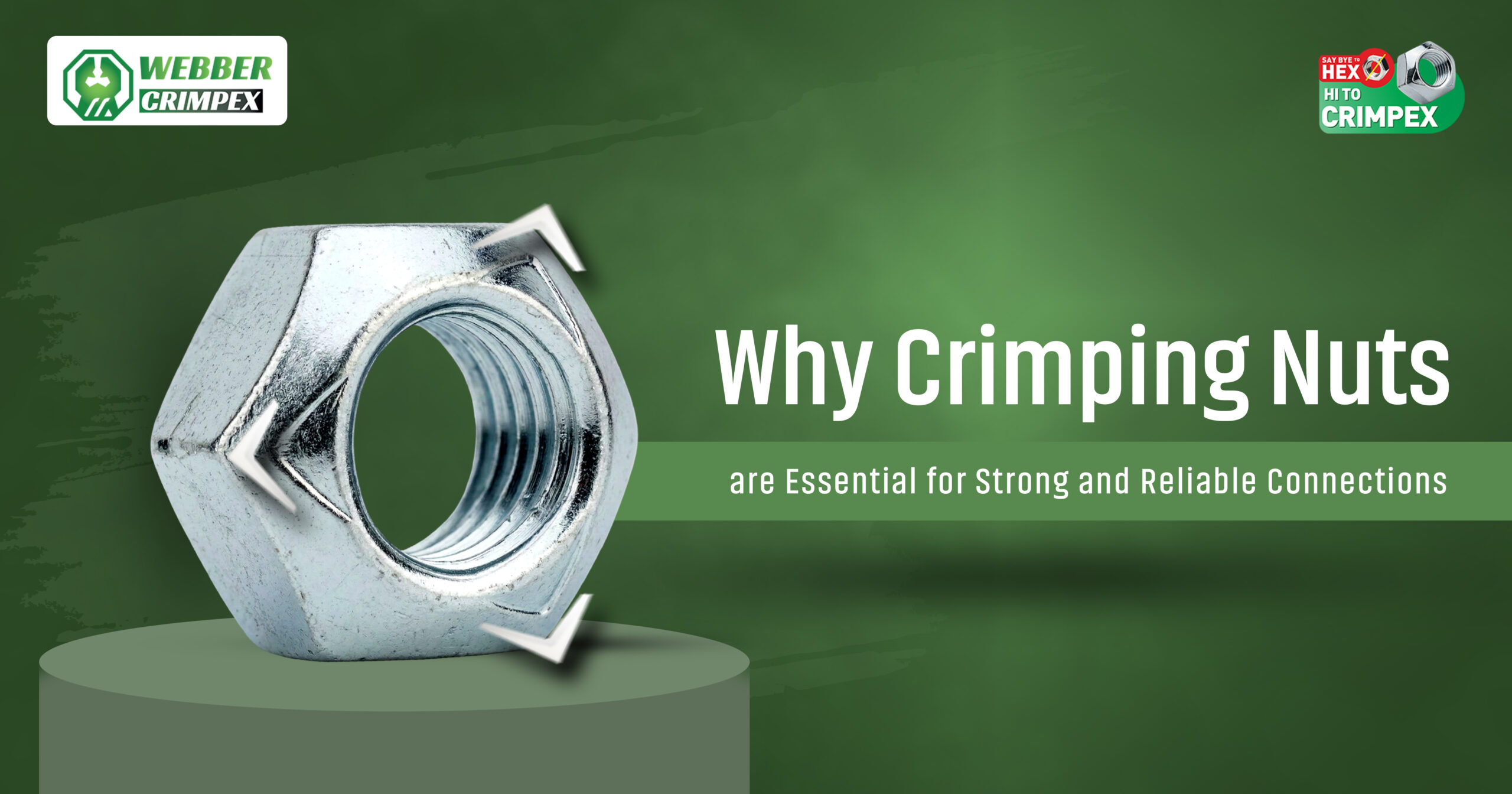
The most common industrial application of the principle is the crimping nut — a nut where a section has been deformed onto the bolt threads to hold it in place and resist loosening. Unlike a standard nut, which relies on the friction and thread tension between the nut and the bolt to hold itself in place and can work loose under load, a crimped nut cannot unwind from the bolt it has been installed on — making it a semi-permanent fastening solution.
Crimped fastening solutions are generally chosen for an application when:
- Resistance to vibration loosening is required
- A secure, semi-permanent fastening is preferred over the life of the equipment
- Consistent, reliable performance of large batches of installed fasteners is needed
- Maintenance and retightening intervals can be reduced across the life of the equipment
- A reliable solution is required in thin sheet metal or high-load structural joints
The actual performance of the fastener is dependent on the design, materials used, and the conditions it is installed in.
How do crimped fasteners work?
The crimping process applies controlled force to permanently deform a section of a fastener onto the mating part. One typical process for the installation is as follows:
- Fastener Positioning
The fastener, such as a nut or stud, is placed on the bolt thread or installed into the defined location.
- Application of Crimping Force
A defined force is applied to the deformable section of the fastener.
- Controlled Deformation
The selected section is deformed to create a mechanical lock against the threads of the mating bolt or base material.
- Mechanical Retention
The fastener remains permanently secured in its intended location even under applied vibrations and load during service.
As a controlled process, the method enables consistently reliable performance of fastened connections when installed in large volumes or on high-volume production lines.
Types of crimped fasteners
Crimped fastening solutions come in several different variants designed to suit the requirements of the application and load conditions.
Crimping Nuts
Crimping nuts are the most common type of crimped fastener used in an industrial setting. A section of the nut is deformed onto the bolt threads during installation to secure a stable, semi-permanent connection that resists loosening. The nuts find primary applications in thin sheet metal and high-load structural joints.
Crimped Studs
Crimped studs provide a permanently retained fastening point that allows a component to be positioned and secured around a fixed location. They allow for repeat assembly around a fixed point.
Crimped Inserts
Crimped inserts are used to form durable internal threads in materials or thin components where conventional threading is not possible or desired. They provide a reinforced connection point for a fastener.
Self-Retaining Fasteners
These fasteners are designed to stay positioned in a component up until the point of final assembly, reducing loose hardware and reducing complexity in the manufacturing process.
Benefits of crimped fasteners
- Secure Mechanical Retention
The deformation process creates a mechanical lock that holds the fastener in its intended position.
- Resistance to Vibration
Properly designed and installed crimped fasteners maintain a secure connection in applications that undergo continuous vibration and movement.
- Reduced Maintenance Burden
With the ability to sustain a secure connection over the life of the equipment, crimped fasteners reduce the need for re-tightening and maintenance intervals.
- Consistent Installation Performance
With the proper tools and processes in place, crimping provides a reliable and repeatable fastening connection for large volumes of installed fasteners.
- Space-Efficient Design
Many crimped fasteners are designed to be incorporated into compact assemblies, utilising the space available efficiently.
- Reduced Assembly Complexity
Where applicable, incorporating a crimped fastener into the design reduces the number of loose hardware items required for the assembly.
Applications of crimped fasteners
Crimped fasteners are utilised across a range of industries where a secure connection is required to ensure the safety and integrity of equipment.
Cement and Steel Plants
Cement and steel manufacturing processes involve mechanical operations that put significant stress and vibration on equipment and structures. Crimping nuts and related fasteners secure component assemblies where a conventional nut would be prone to loosening under the service conditions.
Power Generation and Engineering
Fastening components must withstand the operating stresses and thermal cycles applied to power plant equipment and engineered assemblies.
Marine and Offshore Applications
Equipment exposed to continuous vibrations, load, and challenging environmental conditions utilise crimped fasteners to ensure connections do not unexpectedly loosen.
Industrial Machinery
Machinery manufacturers utilise mechanically retained nuts for brackets, panels, enclosures, and other structural assemblies that require reliable fastening and high production rates.
Construction Equipment
Heavy equipment exposed to mechanical stresses and vibratory loads benefits from the use of crimped fasteners in suitable structural and non-structural components.
Automotive Manufacturing
Automotive assemblies undergo substantial vibratory loading and have demanding operating conditions. Crimped nuts and inserts provide durable, integrated fastening points in body panels, brackets, and other components.
Crimped Fasteners vs Conventional Fasteners
Conventional threaded fastening methods utilise the friction and tension of the mating threads to ensure a nut remains secured on a bolt — but these connections are generally more susceptible to loosening under vibratory or thermal loading and require additional washers, threadlocking compounds, or regular retightening throughout the service life of the equipment.
A crimped fastener provides an additional mechanical lock beyond conventional tensioning, generally improving the resistance to loosening. As such, they are typically a preferred choice in applications requiring high levels of vibration resistance and where regular access or maintenance is not possible.
The right choice depends on base material and thickness, required thread size and load rating, installation access, vibration and thermal conditions in service, production volume, and required corrosion resistance. For a detailed comparison, see our guide on crimped nuts vs normal nuts.
How to select the right crimped fastener
Material
The material of the fastener needs to be selected to suit the mechanical, environmental, and corrosion resistance requirements of the application. Stainless steel is the typical choice for demanding industrial and marine conditions.
Component Thickness
The thickness of the material being joined, as well as its overall characteristics, will inform what fastener design and installation method can be utilised.
Thread Requirements
The required thread size and strength should be matched to the application.
Load and Performance Requirements
Assess the tensile, shear, torque, and vibratory loads that the connection will undergo.
Installation Process
Ensure that the selected fastener can be utilised with the available equipment and manufacturing process.
Surface Finish and Corrosion Resistance
In highly demanding environments, additional coatings or grades may be necessary for the intended service life.
Custom Crimped Fasteners for Industrial Applications
Off-the-shelf fasteners do not always suit the specific dimensional or material requirements of an application. Custom-engineered crimped fasteners can be developed to utilise specific component configurations and load ratings.
Webber Crimpex designs and manufactures precision fastening solutions, including crimping nuts, bolts, screws, washers, and custom fasteners, for cement, steel, power, marine, and other demanding industrial applications. The design and specification process for a fastener takes into account the component configuration, material, dimensions, mechanical requirements, and production needs.
Why Fastener Engineering Matters
While a fastener may only form a small part of an assembly, its performance and reliability are critical to the operation of the equipment. Fastening performance also impacts the wider production and maintenance efficiency of equipment — a crimped fastener selected to suit the full operating conditions of the application reduces unplanned downtime, maintenance burden and assembly complexity.
This is why fastener selection should consider the complete operating environment, rather than just the characteristics of the component it is being installed into.
ALSO CHECK –Why Industries Are Switching to High-Strength Crimping Nuts in 2026
Conclusion
Crimped fasteners are a reliable choice in applications where a secure, semi-permanent connection is necessary. Mechanically locking a nut onto the bolt thread ensures resistance to loosening under vibration, making crimped nuts and related components a preferred choice in the industries that can least afford a fastener failure — cement, steel, power, marine and heavy industrial manufacturing.
Webber Crimpex designs and manufactures precision crimping nuts, bolts, screws, washers, and custom fasteners for demanding industrial applications. Contact Webber Crimpex to discuss your fastening requirements.