ISO vs DIN vs ASTM Fasteners: Standards Explained for Indian Industries
We clearly see one common confusion again and again. Many buyers mix up standards while ordering fasteners. Therefore, this guide on ISO vs DIN vs ASTM Fasteners is written to clear that confusion in simple words. Moreover, we explain how each standard affects strength, fit and safety in Indian industries. Since wrong standards lead to costly rework, understanding industrial fastener standards is not optional anymore. This article focuses only on practical factory level clarity and not textbook theory.
Understanding Fastener Standards in Manufacturing
Fastener standards exist to control size, strength and quality. Therefore, they help different parts fit together without failure. In Indian industries, multiple standards are used because equipment comes from many countries. As a result, engineers must understand industrial fastener standards clearly. Otherwise, mismatch issues appear during installation. Moreover, standards also decide material grade, tolerance and testing method. Because of this, standards directly impact product life and safety.
At Webber Crimpex, we advise clients to never select fasteners only by diameter and length. Instead, checking the standard is equally important. Therefore, learning ISO vs DIN vs ASTM Fasteners helps avoid wrong purchases and production delays.
What Is ISO Fastener Standard
International Organization for Standardization creates ISO standards that are globally accepted. ISO fasteners are designed to work across countries without confusion. Therefore, they are widely used in Indian export oriented industries. Moreover, ISO standards focus on metric dimensions and uniform tolerance.
In industrial fastener standards, ISO stands out for global compatibility. As a result, many Indian OEMs prefer ISO fasteners for machinery that is shipped abroad. Furthermore, ISO fasteners are commonly available in stainless steel and alloy steel. For this reason, sourcing becomes easier and faster for manufacturers.
Key Features of ISO Fasteners
ISO fasteners follow strict dimensional control. Therefore, parts fit smoothly during assembly. Moreover, ISO grades are clearly defined for strength and corrosion resistance. In ISO vs DIN vs ASTM Fasteners, ISO is easier to understand for new engineers.
Common ISO fastener benefits include
- Metric thread system for uniformity
- Clear strength class marking
- Global acceptance across industries
At Webber Crimpex, we supply ISO fasteners mainly to automation and electrical panel manufacturers. Because consistency matters there, ISO becomes the safer choice.
What Is DIN Fastener Standard
Deutsches Institut für Normung publishes DIN standards mainly used in Germany and Europe. However, many Indian industries still use DIN fasteners. This is because older machines were imported from Europe. Therefore, DIN remains relevant in ISO vs DIN vs ASTM Fasteners discussions.
DIN standards often go deeper into design details. As a result, they specify head shapes, drive types and tolerance very clearly. Moreover, DIN fasteners usually come with detailed drawings. Because of that, engineers like DIN for precision assemblies.
Key Features of DIN Fasteners
DIN fasteners are known for tight tolerance and specific geometry. Therefore, they are preferred where alignment matters. In ISO vs DIN vs ASTM Fasteners, DIN often overlaps with ISO but small dimensional differences exist.
Main DIN fastener characteristics
- High dimensional accuracy
- Detailed design specification
- Widely used in mechanical assemblies
At Webber Crimpex, we usually recommend DIN fasteners only when machines explicitly demand them. Otherwise, ISO works better for general use.
What Is ASTM Fastener Standard
ASTM International develops ASTM standards mainly for material properties. ASTM fasteners are common in oil gas power plants and infrastructure projects. Therefore, ASTM plays a big role in ISO vs DIN vs ASTM Fasteners comparison.
Unlike ISO and DIN, ASTM focuses more on material testing and performance. As a result, ASTM fasteners are often heavier and stronger. Moreover, ASTM standards are mostly inch based. Because of this, Indian users must be careful during selection.
Key Features of ASTM Fasteners
ASTM fasteners are strength driven. Therefore, they are chosen for extreme conditions. In industrial fastener standards, ASTM is preferred where load and safety matter more than size compatibility.
Important ASTM fastener traits
- Strong focus on material testing
- Inch based dimensions
- Used in heavy engineering sectors
At Webber Crimpex, we supply ASTM fasteners mainly for EPC projects and industrial structures. Because wrong grade here can cause failure, selection must be done carefully.
ISO vs DIN vs ASTM Fasteners: Dimensional Differences
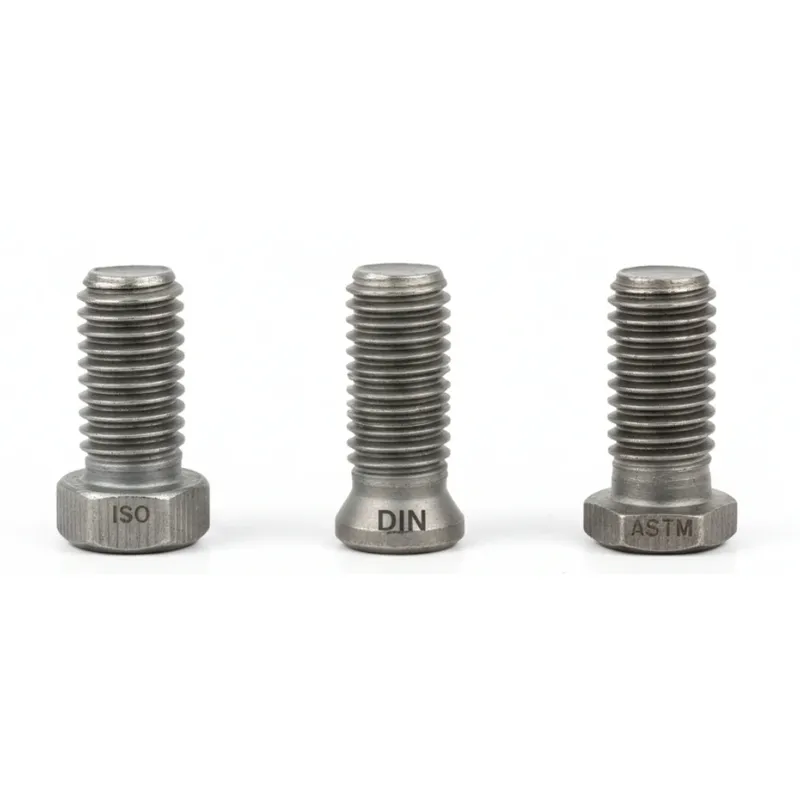
Dimensions create the biggest confusion. ISO and DIN mostly use metric sizes. However, ASTM often uses imperial sizes. Therefore, mixing them leads to assembly issues. In industrial fastener standards, dimensional mismatch is the most common mistake we see.
For example, an M10 ISO bolt cannot directly replace an ASTM bolt of similar size. Because of thread pitch difference, fitment fails. Therefore, we always advise checking drawings before ordering.
ISO vs DIN vs ASTM Fasteners: Material Grades
Material grades differ significantly. ISO uses property classes like 8.8 or 10.9. DIN uses similar markings but sometimes with added geometry rules. ASTM uses grade names like A325 or A193. Therefore, understanding industrial fastener standards helps avoid wrong substitutions.
Moreover, ASTM grades often specify chemical composition clearly. Because of that, they suit high temperature environments. ISO grades are simpler and easier for general manufacturing.
ISO vs DIN vs ASTM Fasteners: Application in Indian Industries
Indian industries use all three standards. Therefore, choosing depends on application. In ISO vs DIN vs ASTM Fasteners, usage can be broadly grouped.
- ISO for automation electrical and exports
- DIN for European machinery
- ASTM for infrastructure and energy
At Webber Crimpex, we advise clients based on machine origin and working condition. Because one standard does not fit all, guidance matters.
ISO vs DIN vs ASTM Fasteners: Availability in India
ISO fasteners are easiest to source locally. Therefore, lead time stays low. DIN fasteners are also available but some sizes need custom production. ASTM fasteners sometimes require longer delivery. Because of this, industrial fastener standards choice also affects project timeline.
For urgent production lines, ISO becomes the practical option. However, for regulated projects, ASTM remains mandatory.
| Parameter | ISO Fasteners | DIN Fasteners | ASTM Fasteners |
|---|---|---|---|
| Origin | International | Germany | USA |
| Units | Metric | Metric | Inch |
| Focus | Dimensions and strength | Design precision | Material performance |
| Indian Usage | High | Medium | Project based |
| Export Friendly | Yes | Limited | Yes |
How Webber Crimpex Helps in Standard Selection
At Webber Crimpex, we do not just sell fasteners. Instead, we advise based on application. Therefore, when clients ask about ISO vs DIN vs ASTM Fasteners, we first study drawings and load conditions. After that, we suggest the correct standard.
If you are unsure, visit our product guide on fastener solutions. Moreover, you can also explore our for practical guidance.
Common Mistakes While Choosing Fastener Standards
Many buyers assume standards are interchangeable. That assumption is wrong. In industrial fastener standards, interchangeability is limited. Therefore, mistakes happen when cost is prioritized over compatibility.
Common errors include
- Mixing inch and metric threads
- Ignoring strength grade
- Replacing ASTM with ISO without approval
Avoiding these saves money and prevents downtime.
Why Indian Industries Must Care About Standards
Indian manufacturing is moving towards global markets. Therefore, standard compliance matters more now. In ISO vs DIN vs ASTM Fasteners, correct choice improves safety and export acceptance. Moreover, it reduces inspection rejection.
At Webber Crimpex, we believe educated buyers build stronger supply chains. Because of that, we share knowledge openly.
Future Trend of Fastener Standards in India
ISO adoption is increasing due to export growth. DIN usage is slowly reducing except in legacy machines. ASTM demand is stable for infrastructure. Therefore, ISO vs DIN vs ASTM Fasteners understanding will remain critical.
Industries that invest time in learning standards face fewer failures. That’s a simple fact.
When required, you can refer to the official ISO documentation available at https://www.iso.org. This helps verify specifications.
FAQs
There is no universal best. ISO suits general manufacturing. DIN suits precision machines. ASTM suits heavy load projects.
Sometimes yes but only after checking dimensions and tolerance.
In many cases yes because ASTM focuses on material performance.
Because material testing and import dependency increase cost.
We study application and guide selection to avoid failure.